For admissions or other details, call us on +91-9810479477

BCA vs B.Tech CSE in 2026: Which Degree Unlocks High-Paying Tech Careers Faster?
Choosing the right undergraduate degree after High School (12th Grade) is one of the most critical decisions for any aspiring tech professional. If you want to build a career in software development, artificial intelligence, or cloud architecture, you have likely narrowed your choices down to two popular programs: BCA (Bachelor of Computer Applications) and B.Tech CSE (Computer Science Engineering).
Historically, B.Tech was viewed as the standard path for software engineering. However, as the tech landscape shifts toward specialized certifications, practical skills, and rapid deployment, the BCA degree has emerged as a high-value, fast-track alternative.
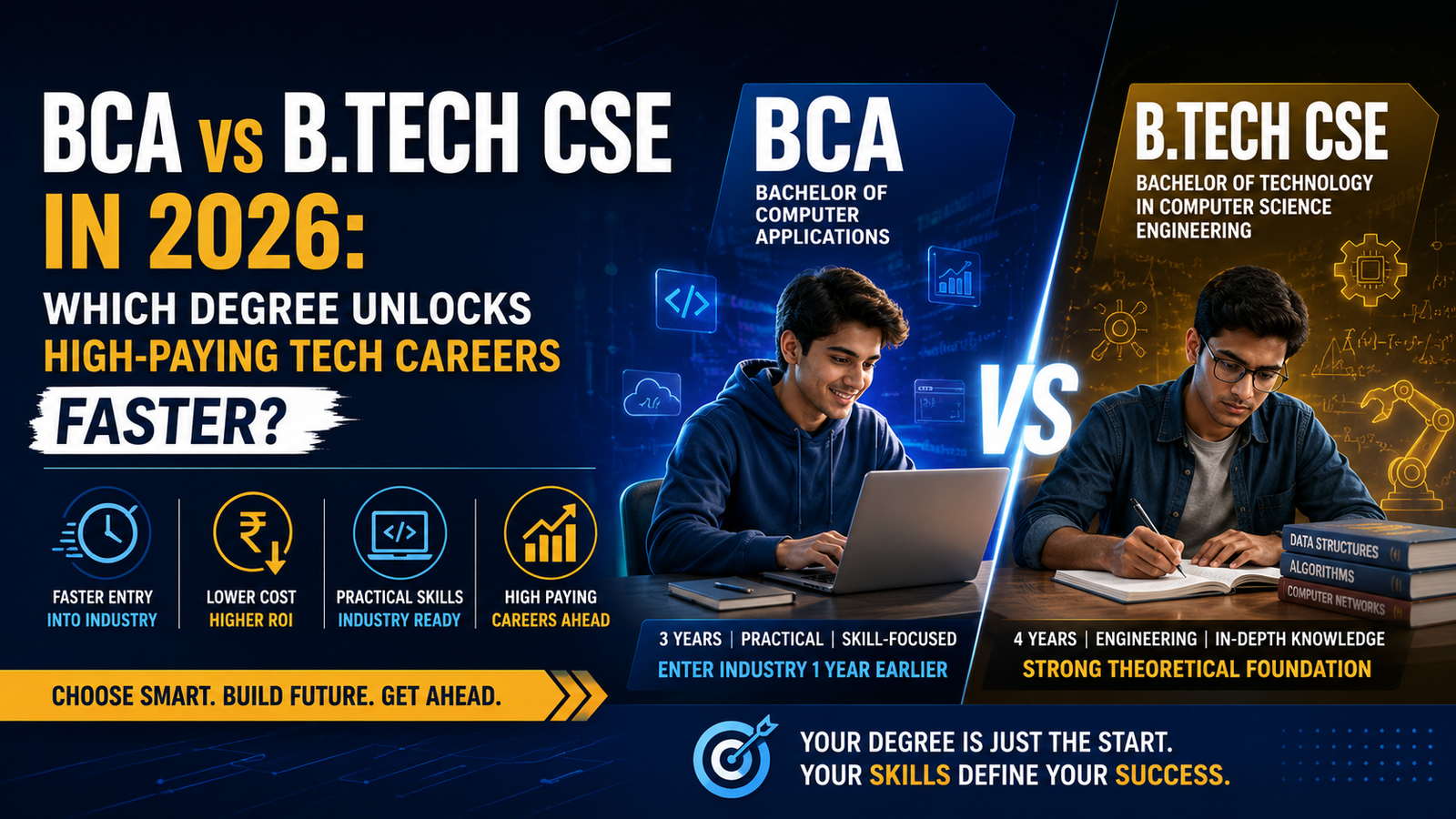
Here is an side-by-side comparison to help you determine which degree aligns best with your career goals, budget, and timeline.
At a Glance: Key Differences
| Feature | BCA (Bachelor of Computer Applications) | B.Tech CSE (Computer Science Engineering) |
| Duration | 3 Years | 4 Years |
| Primary Focus | Software application, programming, AI/BI, and practical tech tools | Deep hardware engineering, mathematics, and theoretical computing |
| Eligibility | Open to Science, Commerce, and Arts streams (varies by institute) | Requires Class 12 Science (Physics, Chemistry, Math) + Entrance Exams |
| Industry Readiness | High emphasis on practical coding, web development, & certifications | Comprehensive theoretical engineering background |
| Time to Industry | Fast: Graduates enter the workforce or start earning 1 year earlier | Standard 4-year academic cycle |
Practical Comparison
Curriculum Focus: Practical Skills vs. Theoretical Engineering
The biggest difference between the two programs lies in how technology is taught.
- B.Tech CSE treats computing as an engineering discipline. You spend significant time studying core sciences, physics, complex calculus, electrical circuits, and theoretical system architectures before diving into application building.
- BCA focuses directly on application software, database management, full-stack web development, and programming languages (Python, Java, C++). Because it is a 3-year application-focused program, the curriculum adapts quickly to modern industry demands—integrating practical tracks like Artificial Intelligence (AI), Business Intelligence (BI), and Digital Marketing.
Time-to-Market & Financial ROI
In today’s tech industry, skills and project experience often outweigh degree length.
Standard Path (B.Tech CSE): ── 4 Years College ────────────────────────► Enter Workforce
BCA + Industry Credentials: ── 3 Years College + Practical Certs ──────► Enter Workforce (1 Year Ahead)
- Earn a Year Earlier: A 3-year BCA allows you to graduate, gain real-world industry experience, or begin earning a full-time income a year ahead of engineering students.
- Lower Tuition Cost: BCA programs typically carry lower tuition fees than 4-year B.Tech programs, offering a significantly higher Return on Investment (ROI).
- Skill-First Hiring: Global recruiters—including IBM, TCS, Wipro, and emerging startups—increasingly hire based on practical skill demonstrations, GitHub portfolios, and specialized certifications rather than degree titles alone.
Key Takeaway: If your goal is to master coding, build applications, and enter the corporate tech ecosystem without spending 4 years on engineering theory, BCA offers a direct and cost-effective path.
Career Roles & Salary Potential
Both BCA and B.Tech graduates target similar job roles in top Bluechip companies. What sets high earners apart is their portfolio, hands-on internships, and specialized skills.
High-Demand Career Paths for BCA Graduates:
- Full-Stack Developer: Building responsive web and mobile applications using React, Node.js, and modern frameworks.
- AI & Business Intelligence Analyst: Leveraging data analytics tools (Power BI, Python, SQL) to drive corporate decisions.
- Cloud & DevOps Associate: Managing deployment pipelines on platforms like AWS and Microsoft Azure.
- Cybersecurity Analyst: Safeguarding network infrastructure and corporate data assets.
Why Pursuing BCA at NDIIT Gives You an Edge
At the New Delhi Institute of Information Technology (NDIIT), the 3-year BCA program (affiliated with Rajasthan University) goes beyond traditional classroom lectures to ensure 100% industry readiness.
- Integrated Certifications: Gain in-demand expertise with built-in certifications in Artificial Intelligence, Business Intelligence, Digital Marketing, and Corporate Communications.
- 6-Month Corporate Internship: Apply your skills in real-world business environments during an extended internship before graduation.
- Bluechip Placement Network: Benefit from dedicated career placement support, Personality Development Programs (PDP), and campus recruiting drives with top corporate partners.
- Global Exposure: Opportunities for foreign language training (Japanese, Spanish, French) and international academic tie-ups.
Which Path Should You Choose?
- Choose B.Tech CSE if: You have a strong background in advanced mathematics/physics, want to study hardware engineering and deep system theory, and don’t mind a 4-year commitment.
- Choose BCA if: You want a focused, 3-year practical tech degree that emphasizes software development, job-ready certifications, and early entry into high-paying IT roles.