For admissions or other details, call us on +91-9810479477

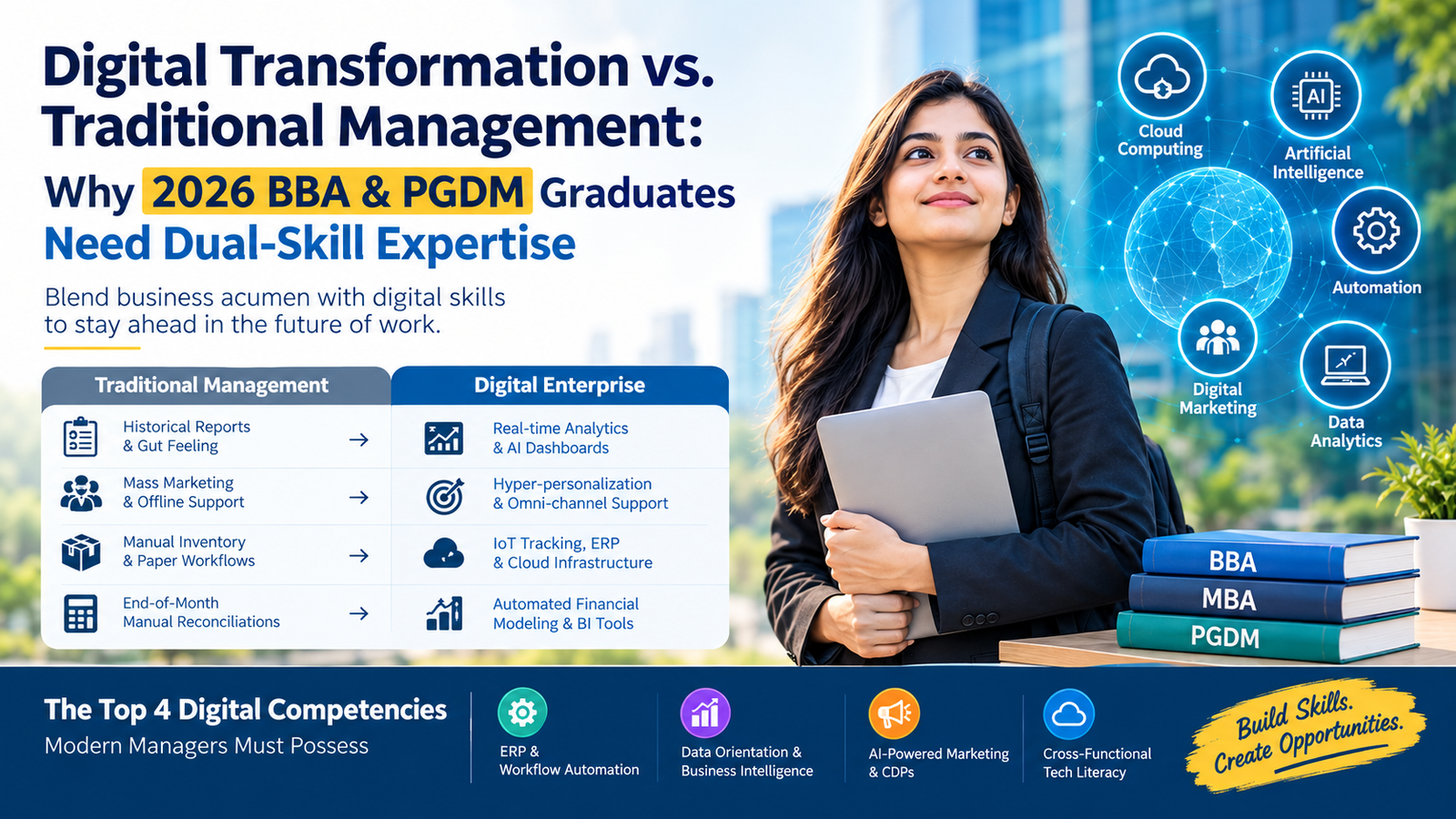
Digital Transformation vs. Traditional Management: Why 2026 BBA & PGDM Graduates Need Dual-Skill Expertise
The global business landscape has reached a decisive turning point. Traditional management strategies—relying solely on manual reporting, static financial models, and offline operations—are rapidly giving way to AI-driven, cloud-first enterprise architectures.
For students stepping into the corporate world, holding a business degree is no longer enough. Modern organizations require hybrid managers: business leaders who possess traditional management fundamentals while seamlessly orchestrating digital systems, automation tools, and data analytics.
Whether you are considering a BBA, MBA, or PGDM program, understanding how digital transformation alters core business functions is essential to building a high-growth career.
The Paradigm Shift: Traditional Management vs. Digital Enterprise
Business Domain | Traditional Management Approach | Digital Transformation Approach |
Decision-Making | Historical quarterly reports & gut-feeling intuition | Real-time predictive analytics & automated AI dashboards |
Customer Engagement | Generalized mass marketing & offline support | AI-driven hyper-personalization & omni-channel automation |
Supply Chain & Operations | Manual inventory tracking & paper-based workflows | IoT real-time tracking, ERP automation, & cloud infrastructure |
Financial Oversight | End-of-month manual ledger reconciliations | Automated financial modeling & Business Intelligence (BI) tools |
The Top 4 Digital Competencies Modern Managers Must Possess
To lead teams and scale operations in a digital-first economy, future managers must bridge the gap between business strategy and tech execution.
- Enterprise Resource Planning (ERP) & Workflow Automation
Modern enterprises rely on integrated platforms like SAP, Microsoft Dynamics, and Salesforce to manage operations. Managers who understand how to configure workflow automation, optimize cross-departmental data flows, and remove operational bottlenecks are invaluable assets to leadership teams.
- Data Orientation & Business Intelligence (BI)
Data is the primary currency of corporate strategy. Beyond reading basic balance sheets, modern managers are expected to run SQL queries, extract operational insights, and turn raw data into actionable visual dashboards using tools like Power BI and Tableau.
- AI-Powered Marketing & Customer Data Platforms (CDPs)
Digital marketing has evolved beyond simple social media posts. Management professionals must master programmatic advertising, customer lifetime value (CLV) predictive modeling, dynamic pricing algorithms, and conversion rate optimization (CRO) strategies.
- Cross-Functional Tech Literacy
A manager does not need to write complex software code, but they must understand how APIs work, how cloud architectures store data securely, and how software development lifecycles (Agile/Scrum) operate. This enables seamless collaboration between executive leadership and technical dev teams.
How NDIIT Prepares You to Become a Dual-Skill Business Leader
At NDIIT (New Delhi Institute of Information Technology), business education is specifically designed to eliminate the gap between academic theory and high-level corporate expectations.
- AI & Tech-Integrated Management Curriculum: NDIIT embeds specialized training modules—including Business Intelligence & Analytics, Enterprise Resource Planning (ERP), Advanced Digital Marketing, and Corporate Communication—directly into management programs.
- Premier Academic Tie-ups: Students get access to elite certification modules, such as Innovation & IT Management (IIM Bangalore) and Business Analytics for Management Decisions (IIT Kharagpur), giving their resumes a distinctive edge.
- Strategic Industrial Location: Situated in Delhi near major commercial and corporate hubs (surrounded by 5,000+ companies across Okhla Industrial Estate and Nehru Place), NDIIT provides real-world corporate exposure from day one.
- 6-Month Extended Corporate Internships: Gain deep operational experience inside Bluechip companies through structured 6-month internships aimed at converting into Pre-Placement Offers (PPOs).
Step Into the Future of Global Management
Equip yourself with the dual-skill expertise needed to lead digital-first enterprises.